Hello SaugaTech Community,
Last month, Anthropic—the company behind Claude AI—agreed to pay $1.5 billion to settle a class-action lawsuit with book publishers and authors. It’s the largest copyright settlement in U.S. history, and it’s forcing the AI industry to confront a question that every transformative technology eventually faces: How do you build on the work of others without destroying the value of what they created?
This isn’t new territory. The music industry faced it with Napster. Publishers faced it with Google Books. Every platform economy wrestles with it. But for AI companies and the professionals building these systems, the Anthropic settlement represents more than a legal precedent—it’s a business model reckoning.
📋 In This Edition:
🚀 First Things First: Join us for SaugaTech Meetup #6 - Practical AI for Career Growth, where we’ll explore AI skills that matter
⚖️ Tech in Focus: Anthropic’s $1.5B settlement and what it means for AI development
📚 The Napster Lesson: How music’s copyright battle reshaped an entire industry
🍁 Canadian Spotlight: OpenAI eyes Canada as copyright battles rage south of the border
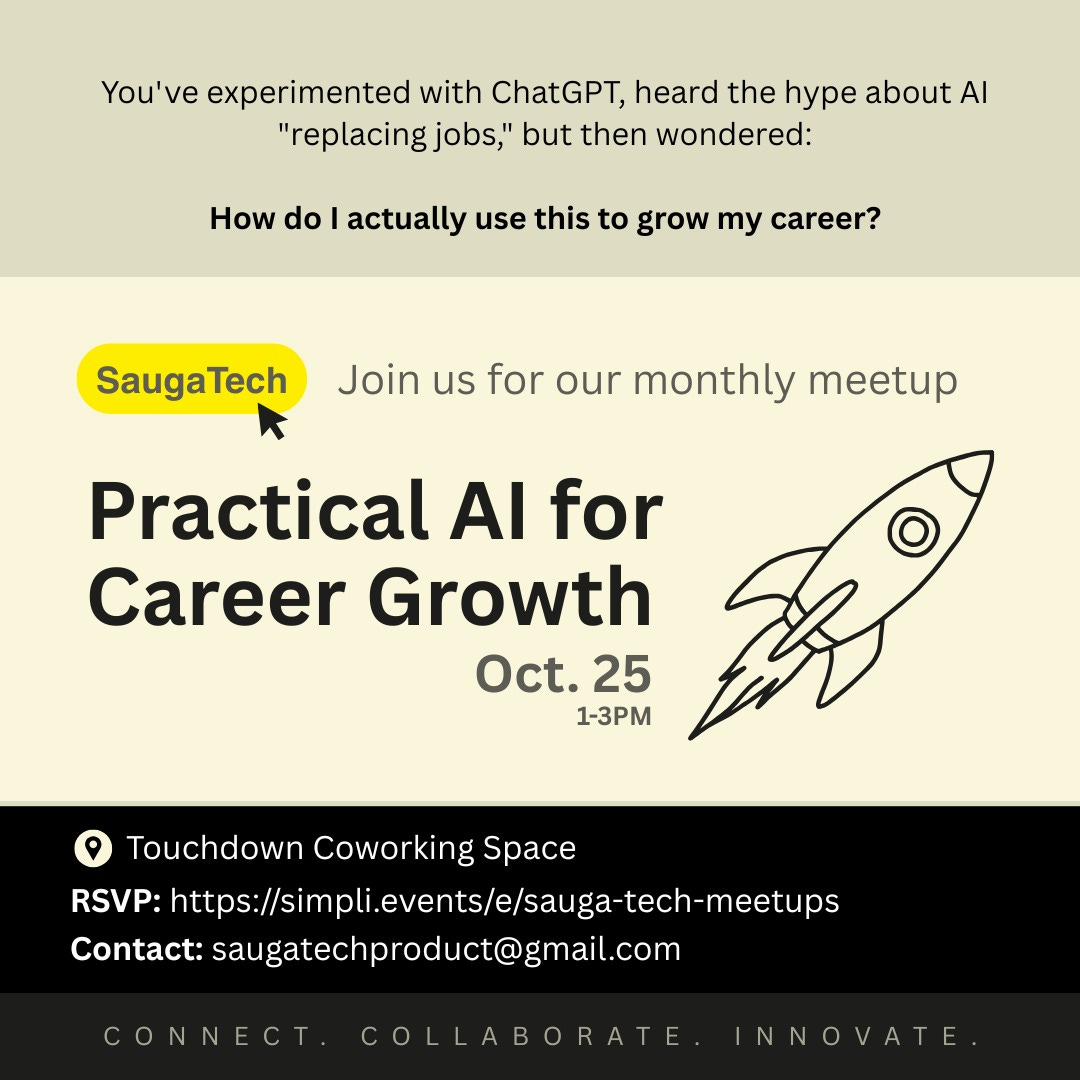
🚀 First Things First: SaugaTech Meetup#6: Building AI Skills the Right Way - 25 Oct 2025
Practical AI for Career Growth
You’ve probably experimented with ChatGPT, heard the hype about AI “replacing jobs,” and wondered: How do I actually use this to grow my career?
At SaugaTech Meetup #6, we’re cutting through the noise to show you exactly how Product Managers, Developers, and Program Managers are using AI tools right now to work smarter, ship faster, and position themselves for the opportunities ahead.
Date: Saturday, October 25, 2025
Time: 12:30 PM - 3:00 PM
Location: Touchdown Coworking Space, Bristol Circle, Oakville OR Attend Virtually using Google Meet
RSVP: https://simpli.events/e/sauga-tech-meetups
⚖️ Tech in Focus: Anthropic’s $1.5B Settlement and the Price of Progress
TL;DR: Anthropic settled the largest copyright lawsuit in U.S. history by agreeing to pay $1.5 billion to authors and publishers whose books were used to train Claude AI. The settlement—approximately $3,000 per book for 500,000 works—fundamentally changes the economics of AI development.
What Happened
In September 2025, Anthropic agreed to settle a class-action lawsuit alleging the company trained its Claude AI models on pirated books from datasets like “Books3”—a collection of nearly 200,000 copyrighted works scraped from the internet without permission.
The Key Facts:
$1.5 billion total settlement - largest copyright recovery in history
~$3,000 per book for approximately 500,000 works
Judge William Alsup approved the settlement on September 25, 2025
Books3 dataset at the center of the controversy contained works from major publishers and independent authors
The lawsuit alleged Anthropic knowingly used pirated content to train Claude, giving it an unfair competitive advantage by avoiding licensing costs that ethical competitors might have paid.
The Ripple Effects Across AI
For AI Companies: This settlement establishes a pricing floor for copyrighted training data. Every AI lab now knows that “move fast and ask forgiveness later” comes with a $3,000-per-book price tag—minimum.
For Content Creators: Authors and publishers now have leverage. AI companies need their content, and there’s a price for it. Expect licensing deals to become standard rather than exceptional.
For Developers and Engineers: The training pipeline just got more complex. Teams will need to:
Audit training datasets for copyright issues
Implement content filtering and attribution systems
Build provenance tracking into AI systems
Work with legal teams on licensing strategies
For Product Managers: Product roadmaps now include “content licensing” as a line item. Features that depend on copyrighted material need legal clearance, not just technical feasibility.
👉 Lesson: The “data is free” era of AI is over. Training data now has explicit costs, and AI companies must budget for content licensing the way Netflix budgets for content libraries. For tech professionals, understanding copyright and fair use isn’t optional—it’s part of building responsibly.
📚 When Tech Collides with Copyright: The Napster Lesson
Anthropic’s settlement isn’t unprecedented—it’s part of a pattern where transformative technologies collide with intellectual property law, eventually forcing new business models. The clearest parallel comes from music’s digital revolution.
Napster: When Free Music Wasn’t Free (1999-2001)
The Innovation: Napster created peer-to-peer file sharing, letting millions swap MP3 files freely. At its peak in 2001, Napster had 80 million registered users sharing music without paying artists or labels.
The Collision: Record labels sued for copyright infringement. Users were sharing entire albums, destroying CD sales. The RIAA (Recording Industry Association of America) claimed Napster facilitated mass piracy and threatened the entire music industry.
The Legal Battle:
Filed in 1999, case moved quickly through courts
Judge Marilyn Patel issued preliminary injunction in 2000
Napster ordered to remove copyrighted material—an impossible task
Appeals failed; Napster filed for bankruptcy in 2002
The Settlement: Napster was shut down in 2001 and eventually paid $36 million. The music industry won the battle but nearly lost the war—Napster’s user base proved demand for digital music distribution existed.
The Aftermath:
Legal streaming emerged: Spotify (2008), Apple Music (2015), and others built licensing frameworks
New business models: Subscriptions replaced ownership; artists got paid (albeit controversially little)
Industry transformation: Music shifted from physical goods ($13.2B in 2000) to streaming services ($17.5B in 2023)
Platform economics: Spotify now pays out ~$9 billion annually to rights holders
The Lesson: You can’t un-invent the technology, but you can force it into legal frameworks. The companies that survived (Spotify) weren’t the pirates—they were the ones who built sustainable licensing models. Anthropic’s settlement suggests AI is entering its “Spotify phase”—finding ways to pay for content while still delivering transformative technology.
The Pattern: Innovate, Litigate, Adapt
The arc is consistent across disruptive technologies:
Technology disrupts: New capabilities that weren’t possible before
Rights holders sue: Creators whose work is used without permission fight back
Courts decide or parties settle: Legal clarity emerges (slowly)
Business models evolve: Winners are those who find sustainable frameworks
For AI, we’re in phase 3-4 right now. Anthropic’s settlement is the first major resolution, but OpenAI, Meta, and others face similar lawsuits. The industry is figuring out what sustainable AI development looks like.
🍁 Canadian Spotlight: OpenAI Eyes Canada as Copyright Battles Rage
While Anthropic writes a $1.5 billion check to settle copyright claims in the U.S., OpenAI is looking north—and the timing couldn’t be more interesting.
OpenAI Considers Canadian Expansion
Last week at Toronto’s Elevate Festival, Chris Lehane, OpenAI’s Chief Global Affairs Officer, announced the company is seriously considering Canadian expansion. The plans include:
Data center capacity as part of the Stargate infrastructure project
Potential Canadian office (Lehane teased “stay tuned”)
Deeper partnerships with Canadian AI research institutions
Why Canada? Three reasons cited:
World-class AI talent - Vector Institute, CIFAR, UofT, Waterloo, and the researchers who put Canada on the AI map
Research capacity - Strong academic institutions and collaborative ecosystem
Capital availability - Canadian investors and government support for AI infrastructure
Lehane positioned OpenAI as wanting to be a “constructive partner” in building Canada’s sovereign AI capabilities.
What This Means for Canadian Tech Professionals
More AI jobs are coming to Canada—and potentially to the GTA specifically. When OpenAI expands, they won’t just hire ML researchers. They’ll need:
Product Managers who understand AI capabilities and limitations
Engineers building infrastructure, tools, and applications
Operations teams managing data centers and partnerships
Legal and compliance professionals navigating copyright and licensing
Community and partnership managers connecting with Canadian institutions
For SaugaTech community members, this trend is bigger than OpenAI. As AI companies navigate complex copyright landscapes, Canada’s combination of talent, research infrastructure, and responsible innovation culture makes us increasingly attractive.
The opportunity: Build expertise now in responsible AI development—the skills OpenAI and others will be hiring for as they expand here. Understanding both the technical capabilities AND the ethical/legal frameworks isn’t just good practice—it’s what will differentiate Canadian AI professionals in a growing market.
👉 Lesson: While U.S. AI companies fight legal battles, they’re investing in Canadian talent. The professionals who understand copyright, fair use, licensing, and responsible AI development will be the ones leading teams in Canada’s expanding AI sector.
💡 Why This Matters: The New Economics of AI
The Anthropic settlement fundamentally shifts how AI companies operate. Here’s what it means for Canadian tech professionals:
Training Data Now Has a Price Tag: AI companies need licensing agreements, synthetic data generation, and proprietary datasets. The “scrape everything and hope for the best” era is over.
Provenance and Attribution Matter: AI systems will need to show what data was used for training, whether it was licensed, and how to attribute sources—creating demand for developers building transparency tools.
Business Models Are Shifting: Expect higher API prices to cover licensing fees, tiered models with different content rights, and revenue sharing with content creators. Product managers need pricing strategies that account for content costs.
Responsible AI = Competitive Advantage: Companies building ethically from the start will have fewer legal risks, better partnerships with creators, and stronger brand reputation with enterprise customers.
Canadian Opportunity: Canada’s AI research strengths (Vector Institute, CIFAR, UofT, Waterloo) combined with a culture that values responsible innovation positions us well. Canadian companies can differentiate by building AI with transparent, ethical data practices.
Career Impact: Whether you’re at a startup, a major retailer’s tech team, or planning your next move, understanding the intersection of AI, copyright, and business models is increasingly valuable. The Anthropic settlement shows that responsible building is the new competitive advantage.
✨ SaugaTech Epilogue
The Anthropic settlement marks a turning point: AI innovation must now coexist with intellectual property rights, not bulldoze through them.
For tech professionals, this means the skillset is evolving. It’s not enough to know how to build AI systems—you need to understand how to build them responsibly, legally, and sustainably. That means:
Understanding copyright basics and fair use doctrine
Thinking about data provenance and licensing from day one
Building transparency into systems so users know what they’re getting
Designing business models that account for content costs
And here’s what makes this moment particularly exciting for Canadian tech professionals, especially in the GTA: As AI companies navigate copyright complexity in the U.S., they’re looking to Canada for talent, infrastructure, and partnerships. OpenAI’s expansion plans are just the beginning. More AI investment means more roles, more opportunities, and more demand for professionals who understand responsible AI development.
For our community in Mississauga, Brampton, Oakville, and across the region—this isn’t about relocating to San Francisco or even downtown Toronto. The AI jobs are coming here. The question is whether you’ll be ready with the skills that matter: not just technical prowess, but the ethical judgment and legal literacy that defines sustainable AI development.
At SaugaTech Meetup #6, we’re focusing on practical AI skills that are built to last—not just what’s technically possible, but what’s responsibly implementable. Because the best career moves aren’t about chasing hype; they’re about building expertise that remains valuable as the industry matures and as more AI companies establish Canadian operations.
History shows us that technologies don’t disappear after copyright battles—they evolve into sustainable models. Music streaming survived Napster. AI will survive this too. But the winners won’t be the companies that moved fastest—they’ll be the ones that moved smartest. And the same goes for careers.
See you on October 25th , where we’ll dig into AI skills that are practical, ethical, and future-proof—the kind that position you for the AI opportunities coming to the GTA.
Thanks for reading this edition. Until next week 🚀
Onwards and upwards,
Team SaugaTech
CONNECT | COLLABORATE | INNOVATE