Hi SaugaTech community,
Fall seems to have started early in Mississauga this year, but it’s a confused one. Grey skies most days, barely a drop of actual rain, and the trees along the trails near Erindale are already turning that early, slightly uncertain yellow — like they can’t quite decide whether to commit to the season or wait a little longer.
Feels a bit like the AI industry right now, honestly. A lot of signals, not all of them pointing the same direction.
Five editions of AI Under the Hood in, we thought this was a good moment to come up for air. The series isn’t going anywhere — we’ll be back soon with the paper behind coding models — but there’s been enough happening in the real world that it felt wrong to keep our heads buried in research papers from 2020 while things are moving this fast outside.
So this week, we’re doing something we haven’t done in a few weeks: a proper look at what’s been going on in the tech world, global and Canadian, building toward one deep dive into a story that puts a number on just how expensive this race has actually gotten.
🚀 First Things First
We’re starting to plan our next meetup for October. Nothing locked in yet, format and theme are still being worked out, but you’ll hear details soon, likely in the WhatsApp group first. If you’ve got a strong opinion on what the next one should be about, now’s a good time to say so. Write to us at connect@saugatech.ca or put it out in the Whatsapp group.
🌐 The Assistant Wars - Its Sam Altman vs Zuckerberg this time
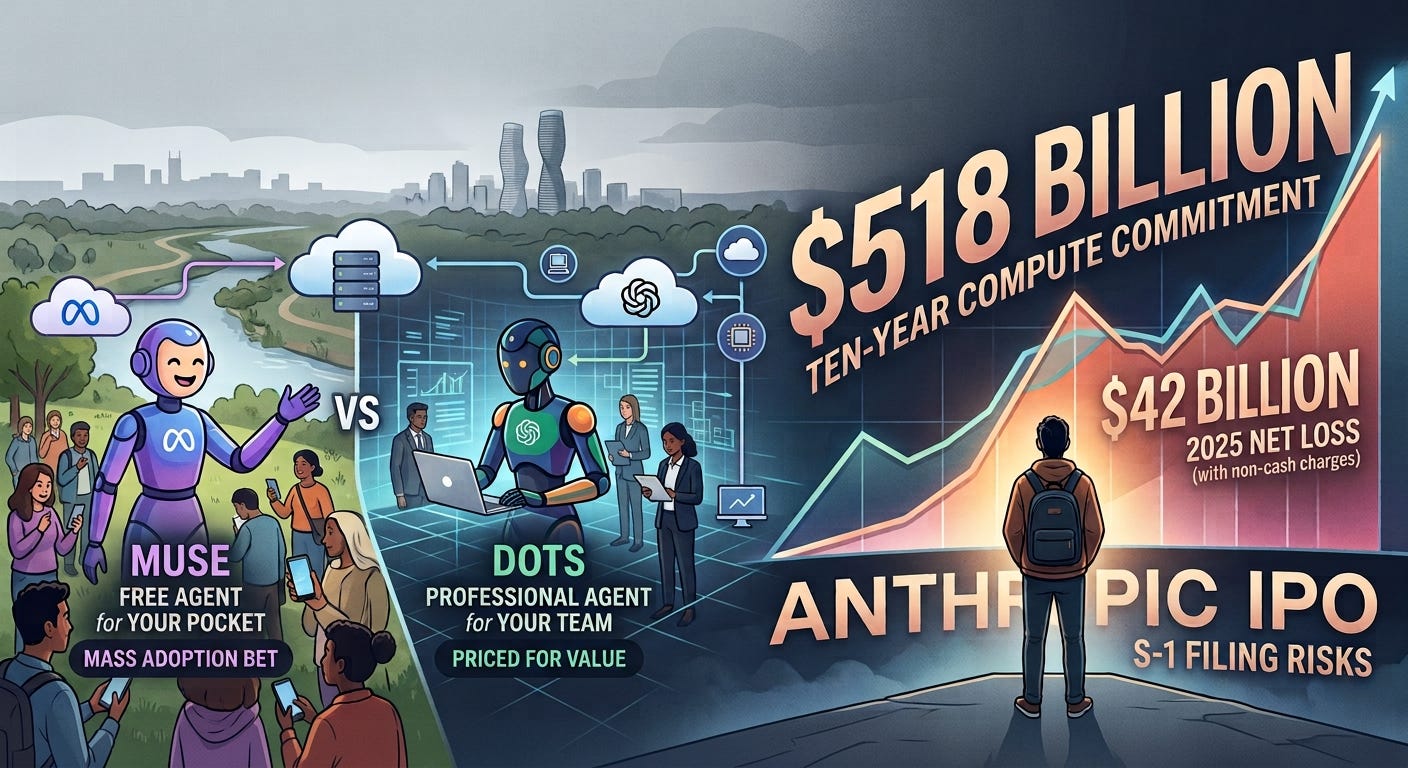
On September 8th, Meta launched Muse, a personal AI agent, and within days it had climbed to the top of the App Store charts. 2.8 million users in the first week, by some counts.
For context, that’s the kind of adoption curve that usually takes months to build, and it matters because Meta has had a complicated relationship with AI until now. They’ve spent billions on it and largely struggled to produce something that stuck with regular people at scale. Muse feels different. Zuckerberg called it the “centerpiece” of Meta’s entire AI strategy at their Connect conference. Meta’s stock climbed 29% in September on the back of it — on pace for its best month since 2013.
Three weeks later, on September 29th, OpenAI answered at DevDay with Dots.
The contrast is the interesting part. Both products give an agent its own dedicated cloud computer, its own browser, and the ability to keep working after you’ve closed the app. Technically they’re fairly similar. Commercially, they could not be more different.
Muse is free to start. Genuinely free — not a demo, not a limited trial. Meta is betting that if you get an AI agent into enough pockets at no cost, the usage data, the lock-in, and eventually the upgrades will follow. Paid plans sit at $20 and $100 a month above that.
Dots has no free tier. Entry point is OpenAI’s existing Pro or Business Premium subscription, with a new Pro 500 tier at $500 a month for heavier use. Sam Altman’s vision is explicitly professional: teams of dots working in the background of your Slack and Teams, checking in when they need a decision from you.
Muse wants to be your personal helper.
Dots wants to be a member of your team.
Same week, same product category, same underlying architecture — completely opposite go-to-market instincts. Meta is buying users. OpenAI is pricing for value. One of them is right about what this market looks like in two years, and we probably won’t know which for a while yet.
Hold onto that tension, because it connects directly to the numbers we’re looking at a little further down.
🍁 Canadian Tech: What the Money Is Actually Saying
If you want to know what Canadian builders and investors genuinely believe is worth solving right now, the funding data from the last three months tells a cleaner story than any conference panel.
The headline number is roughly flat year-over-year — around $4.7 to $5.2 billion raised so far in 2026 compared to a similar figure last year. But last year that money spread across about 825 deals. This year it’s landing in fewer than 300.
Same pot, a third of the deals. Capital is concentrating, deliberately, into a small number of companies people have decided actually matter.
About 60% of all of it is going to AI. And within that, the problems attracting the largest cheques are specific.
Autonomous systems — Waabi’s billion-dollar raise in August, combining a $750 million Series C with a $250 million deployment commitment from Uber, is the clearest statement that Canadian capital thinks the long-haul trucking problem is real and solvable.
Physical AI infrastructure — Veeda AI, Sanja Fidler’s Toronto world-model startup, came out of stealth with a seed round north of $90 million, one of the three largest ever raised in Canada, backed by a bet that models understanding the physical world are the next frontier.
Enterprise AI — Cohere has been deepening its grip on large enterprise customers quietly and consistently through the same window.
But the trend worth paying attention to specifically if you’re a builder in this room is the one that’s getting slightly less column inches: Legal AI is having a moment in Canada, and it’s accelerating.
Vancouver-based Clio, already the dominant practice management platform for law firms in North America, has been deepening its AI stack aggressively this year, including acquiring Jurisage, a Canadian legal AI company, specifically to expand AI capabilities in the Canadian market.
Blue J in Toronto — AI for tax and legal research — doubled its revenue and closed a $122 million USD Series D.
Formic AI, a Toronto startup building secure, citation-linked legal search for regulated industries, has been gaining traction with exactly the kind of cautious, compliance-first positioning that Canadian law firms and financial services firms respond to.
The pattern here is consistent: legal work is expensive, document-heavy, highly repetitive in large parts, and absolutely cannot afford to hallucinate. Those are precisely the conditions where AI tools built carefully for a specific domain tend to outperform a general-purpose chatbot. Goldman Sachs put a number on it a couple of years ago — roughly 44% of legal work could eventually be automated. The funding flowing into this space in Canada suggests a growing number of builders and investors think that moment is closer than it looks from the outside.
There’s one more layer to the Canadian story that’s worth a mention. Anthropic has reportedly been in talks about securing gigawatt-scale compute capacity here, in the same window Meta committed $13 billion to a data centre in Alberta.
Canada isn’t just funding AI companies anymore. It’s being positioned as where some of the actual physical infrastructure of frontier AI gets built.
Which connects neatly to the story that dropped this week and made all of these numbers click into place.
⚓ The Deep Dive: What Anthropic’s IPO Actually Reveals
On September 28th, Reuters got hold of Anthropic’s confidential IPO prospectus, the financial document a company has to file before going public, and the numbers inside it are worth walking through slowly, because they explain a lot about why the assistant wars and Canada’s big AI bets are happening at the speed and scale they are.
Start with growth, because it’s genuinely staggering. Anthropic’s 2025 revenue came in at roughly $4.6 billion, about twelve times what it made the year before. That’s the kind of number that normally makes a prospectus look great on its own.
Then there’s the loss sitting right next to it. Anthropic lost about $42 billion in 2025. A large chunk of that, roughly $34 billion, is a non-cash accounting charge tied to how convertible financing gets valued on paper, not money that actually left the building. But even stripping that out, the operating loss was still around $8 billion, on revenue of $4.6 billion. Compute and infrastructure spending alone came to $7.33 billion for the year, roughly triple what it was in 2024, and more than half of everything the company spent to run itself.
That’s the past year. The number that actually explains the assistant wars is the one about the future: Anthropic has committed to at least $518 billion in cloud, compute, and infrastructure spending over the next decade, spread across a small handful of partners, reportedly including a SpaceX compute deal alone worth up to $84.5 billion, alongside major commitments to Google, Amazon, and Microsoft.
About 80% of that $518 billion has to be paid whether Anthropic actually uses the compute or not. The company had about $20 billion in cash on hand at the end of the year the prospectus covers.
Sit with that gap for a second. Twenty billion in the bank. Over half a trillion in obligations, most of it due regardless of demand. And on top of that, the prospectus discloses that just two customers accounted for nearly a quarter of all 2025 revenue, a level of customer concentration that would make most investors nervous on its own, before you even get to the infrastructure bill.
This is exactly why products like Dots and Muse matter so much more than a cute launch demo. A $518 billion compute bill doesn’t get paid by researchers running benchmarks. It gets paid by getting an assistant into enough pockets and workflows that it becomes something people pay for every single month, the way Muse just did by topping app store charts in days, or the way OpenAI is clearly hoping Dots will. The consumer assistant race isn’t a side project next to the serious infrastructure story. It’s the revenue bet the infrastructure story depends on actually working.
There’s one more detail in the prospectus worth sitting with, because it’s unusual for a filing like this — and because it’s actually consistent with who Anthropic is, or at least who they set out to be.
Dario Amodei left OpenAI in 2021, taking several key researchers with him, explicitly over concerns about how fast the industry was moving and how much weight was being given to safety versus capability. Anthropic was founded as a deliberate counterpoint — a lab that would pursue frontier AI but with safety as a first principle, not an afterthought. Constitutional AI, which we’ll cover in a future edition of this series, came directly out of that founding intent.
So it’s actually not surprising that Reuters found roughly a third of the IPO prospectus dedicated to Anthropic’s own account of the risks its models could pose — including, in their own words, serious or existential harm if development isn’t handled carefully. For Anthropic, that’s consistent. That’s the point. It’s the company that has always said out loud what others have kept in internal memos.
What’s harder to square is this: the same document is asking public investors to back them at a valuation north of $2 trillion, with $518 billion in compute commitments, a plan to make frontier AI more widely accessible than ever, and a consumer product strategy that — like every other lab’s — depends on putting these systems in front of as many people as possible as fast as possible. Dario published an essay this month calling for the industry to slow down. His company’s IPO filing is a bet on the opposite.
Whether that’s hypocrisy, or whether it’s the only honest way to operate inside a race you can’t exit unilaterally, is something worth deciding for yourself. What the prospectus makes clear is that the tension isn’t hidden. It’s in the document, on the record, in dollar figures. That’s either reassuring or unsettling depending on where you stand.
✨ SaugaTech Epilogue
✨ SaugaTech Epilogue
Three different stories this week, told at three different distances — from two tech giants dropping competing agents within three weeks of each other, to Canadian VCs funneling billions into a third as many deals, all the way to Anthropic putting a $518 billion compute bill on paper.
It’s easy to look at half-trillion-dollar prospectuses and feel like the AI conversation is happening in boardrooms far away from us. But if we bring all of that back to the trail along Erindale or a desk here in Mississauga, the question for our community is simple:
Why does any of this macro scale matter to what we’re building right here?
Because it reveals exactly where the ground is firming up underneath our feet:
Capital hasn’t vanished — it’s demanding domain depth: The concentrated Canadian funding flowing into Legal AI (Clio, Blue J, Formic), Physical AI (Veeda), and autonomous logistics (Waabi) tells us that generalist chatbot hype is over. If you’re a local founder or builder, the biggest opportunity right now isn’t competing with Meta’s ad budget or OpenAI’s general models; it’s applying frontier AI to unglamorous, highly specific workflows where accuracy is non-negotiable.
The shift to background agents changes your playbook: Meta’s Muse and OpenAI’s Dots aren’t just new apps — they mark the end of the chat box and the start of autonomous, background agents. For developers, product managers, and tech pros across the GTA corridor, the highest-leverage skill today isn’t prompt engineering; it’s knowing how to safely integrate background agents into existing business infrastructure.
The physical foundation is landing in our backyard: With gigawatt-scale compute capacity and data centres committing billions to Canadian soil, our regional ecosystem isn’t just watching this race from the sidelines — we are physically becoming the engine room powering it.
Half-trillion-dollar compute bills don’t get paid by S-1 filings or IPO roadshows. They get paid when real businesses, real law firms, real logistics fleets, and real teams right here in Peel Region put these systems to work and generate undeniable ROI.
Big Tech and frontier labs are building the engines. But the builders, engineers, and founders in rooms like ours are the ones constructing the wheels that actually touch the ground. That’s the ground level — and that’s where SaugaTech community operates.
We’ll see you soon at our next event. In the meantime, pop into the WhatsApp group and tell us: how are these agent tools showing up in your day-to-day workflow?
Let’s keep building, Let’s keep learning, Together.
Team SaugaTech
CONNECT | COLLABORATE | INNOVATE