Hi SaugaTech Community,
The FIFA World Cup has taken over. There’s no other way to put it.
If you’ve been anywhere near Celebration Square in Mississauga over the last few weeks, you’ll know exactly what we mean. Thousands of people, flags from every corner of the world, the kind of collective energy that only football at this scale can generate. Strangers becoming friends in ninety minutes. The city feeling like a village. It’s been something else.
And Canada — Canada has been right in the middle of it, on both sides of the touchline.
As a host nation, the country delivered. Toronto and Vancouver proved that Canada can run a world-class sporting event with warmth, organisation, and an atmosphere that surprised even the teams who played here.
BMO Field — the smallest venue of the 16 World Cup stadiums — punched well above its weight. Six matches, six sold-out crowds, and a buzz that spilled far beyond the stadium into Little Portugal, Celebration Square, and every fan zone across the GTA. When Portugal manager Roberto Martínez walked out of BMO Field after his side’s dramatic Round of 32 win over Croatia, he told reporters: “I think it’s a shame that there are no more games here in Toronto, because we really enjoyed that. I thought it was an incredible, incredible spectacle for football.” That’s the highest compliment a visiting manager can pay a host city — and Toronto earned it.
As a participant, Les Rouges wrote a story that will be told for a long time. Canada had appeared at two previous World Cups — 1986 and 2022 — and won nothing, scored nothing, left early both times. This time was different. Cyle Larin scored Canada’s first ever World Cup goal against Bosnia at BMO Field. Jonathan David scored a hat-trick in a 6-0 demolition of Qatar — Canada’s first ever win and the biggest winning margin in CONCACAF World Cup history. Stephen Eustáquio’s stoppage-time strike against South Africa in the Round of 32 sent Canada through to the last 16 for the first time ever. Morocco ended the run 3-0 in Houston, though the scoreline flattered them — Canada dominated the first half before the Atlas Lions found their second-half rhythm and pulled clear.
Les Rouges went home. But Canadian football will never be quite the same.
As a community built in Mississauga — one of the host cities’ neighbourhoods — we watched all of this with a particular kind of pride. And as a tech community, we couldn’t help but notice something else running through this tournament alongside the football: the most sophisticated sports technology deployment in history.
That’s what this week’s Compass is about.
🚀 First Things First
Meetup #10 recap is live — the Gandalf demo, the builders showcase, the conversation that stayed with us. Worth a read if you missed it.
And if you’re not in the WhatsApp community yet, that’s where all of this continues between editions: Click here to request to join the group
⚓ What’s Actually Running Under the Hood at FIFA 2026
Every major decision at this tournament — every disallowed goal, every reversed penalty — is being made or unmade by a tech stack most fans couldn’t name.
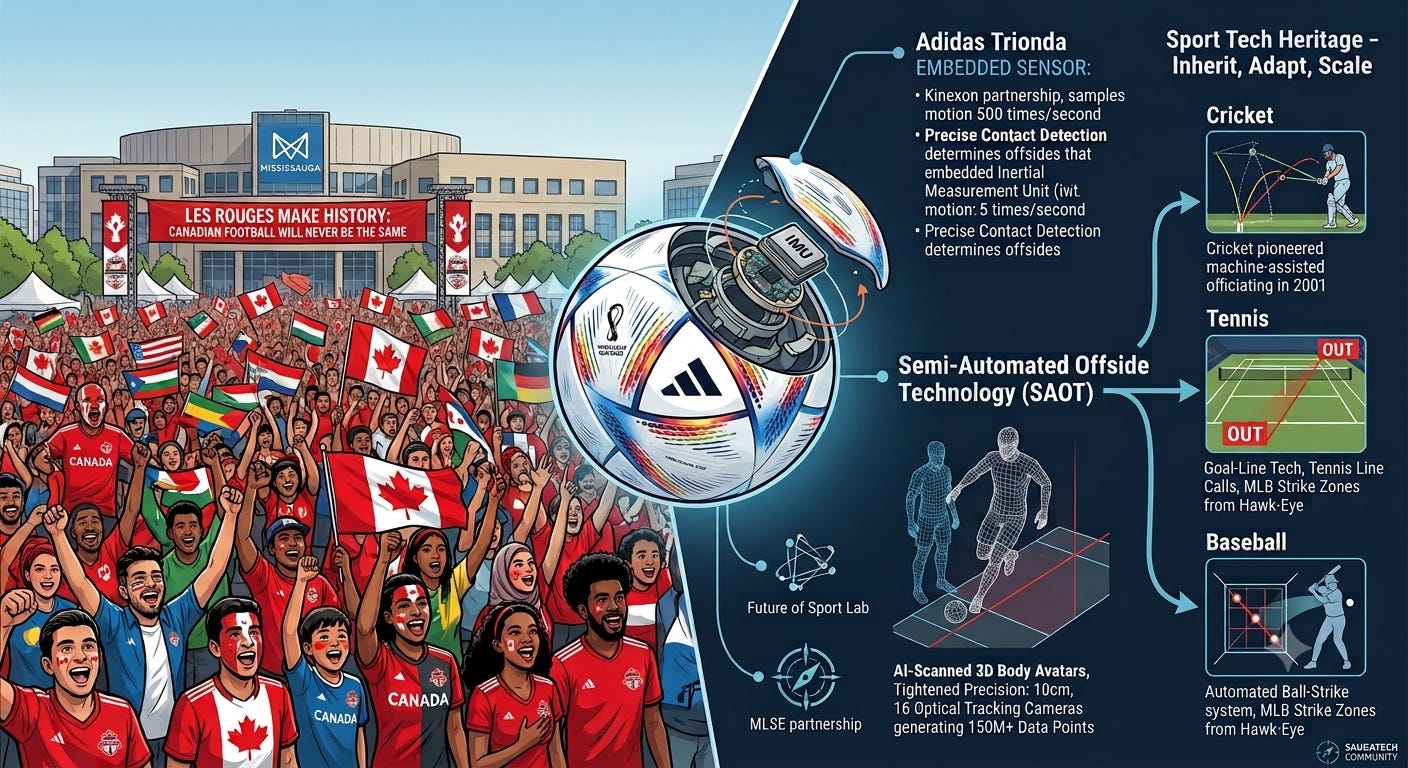
Start with the ball. The Adidas Trionda carries an embedded Inertial Measurement Unit — a sensor combining an accelerometer and a gyroscope, developed in partnership with Kinexon — that samples its own motion 500 times per second. That’s not a camera watching the ball. That’s the ball telling the system exactly what it’s doing, in real time, with millisecond precision. Its primary job is to detect the exact moment of contact — the precise frame at which the ball was last touched before an offside position is measured.
That’s how Croatia’s goal came off the board at BMO Field. The sensor detected that Igor Matanovic had brushed the ball before the pass that set up Gvardiol’s finish. That touch — invisible to everyone in the stadium, invisible to the broadcast cameras — set the offside clock. The ball knew. The system flagged it. Luka Modric’s World Cup was over.
Sitting on top of that ball data is Semi-Automated Offside Technology, or SAOT. Every one of the 1,248 players across 48 squads was scanned before the tournament — using Lenovo hardware and AI — to create a personalised 3D body avatar. During the game, those avatars overlay on real-time tracking data from 16 dedicated optical tracking cameras per stadium generating over 150 million data points per match, and the system calculates the offside line at the exact frame the ball is played. For 2026 the precision threshold was tightened to 10 centimetres — down from 50. That’s why you’re seeing goals disallowed for a shoulder, a toe, a backside.
Referees also wear body cameras in all 104 matches for the first time, and VAR decisions are now explained over the stadium PA — a direct response to the criticism that fans in the ground are left in the dark while TV viewers see everything.
But football didn’t pioneer any of this. Cricket did.
If you follow cricket, the FIFA tech stack will feel familiar — because cricket was solving the problem of machine-assisted officiating two decades before football got there.
Hawk-Eye was invented in 2001, originally for cricket. Six cameras placed around the ground triangulate the ball’s trajectory after pitching, letting the third umpire predict with high accuracy whether a delivery would have hit the stumps. That same Hawk-Eye system now powers FIFA’s goal-line technology, MLB’s automated ball-strike system, and — since 2025 — every line call at Wimbledon, where human line judges have been eliminated entirely. SAOT is a direct descendant of what cricket built first.
Hot Spot uses infrared imaging to detect the heat generated by friction when ball meets bat or pad. Invisible to the naked eye, visible to infrared. The physics that cricket used to adjudicate edge catches in Test matches are now embedded in wearable sports tech measuring muscle exertion and contact impact across multiple sports.
Ultra Edge — Hawk-Eye’s upgrade to the original Snickometer — uses a sensitive microphone in the stump and oscilloscope technology to detect the acoustic signature of ball-on-bat contact. A sharp spike on the waveform confirms the nick. Sound-based contact detection, refined in cricket, is now standard technique across sports officiating.
Cricket, a sport most of North America barely watches, was solving the hard problem of sensor-based officiating long before the World Cup came to Toronto. Sports tech rarely invents from scratch. It inherits, adapts, and scales.
⚓ Beyond Football — Tech That Silently Runs behind Every Major Sport
The World Cup makes sports tech visible. The more interesting work has been running quietly across every major league for years.
Hockey — Every puck in NHL play carries a sensor. Every player wears a tag in their shoulder pads. Cameras feed data to a central system tracking puck position, player speed, shot release time, and zone entries multiple times per second. That data feeds coaching dashboards and powers everything from line-change timing to power play deployment. Catapult and STATSports provide the wearable GPS layer used by teams across multiple sports.
NBA — The league committed to optical player tracking at scale before anyone else. Second Spectrum, the platform that powers NBA.com player tracking, uses computer vision to track every player’s position on the court multiple times per second. The advanced metrics you see on NBA broadcasts — Expected Possession Value, defensive impact scores, passing network analysis — all flow from this system.
Baseball — The Automated Ball-Strike system, built on Hawk-Eye cameras, has been running in the minor leagues for years and is slated for the 2026 ALCS and NLCS. The era of “the umpire’s zone” as a variable that batters and pitchers manage is ending.
Injury prevention — Zone7, an AI injury prediction platform, has been adopted by Premier League clubs, NBA teams, and MLB franchises because the cost of a torn ACL — in contract value and competitive impact — now vastly exceeds the cost of a predictive analytics subscription.
The sports technology market was worth around $3 billion in 2025. It’s projected to reach $10 billion by 2030, growing at over 25% annually. Every sprint, every heartbeat, every puck bounce is data now.
⚓ The GTA Companies Building It
Here’s where it gets local.
Toronto Metropolitan University’s Future of Sport Lab, in partnership with Maple Leaf Sports and Entertainment, is one of the most significant sports tech incubators in Canada. Startups from the FSL program have collectively raised over $100 million.
A few worth knowing:
Pando Partner (Toronto) — a self-serve platform that gives sports and entertainment organisations the tools to manage and measure sponsorship performance. Sponsorship is a multi-billion dollar market that has historically run on relationships and gut feel. Pando is building the analytics layer that makes it data-driven.
TritonWear (Toronto) — wearable performance technology specifically for competitive swimmers. Swimming is over a decade behind other sports in data collection. TritonWear is closing that gap with sensors worn during training that capture stroke mechanics, turn times, and exertion data that coaches have never had access to before.
theScore (Toronto) — now owned by PENN Entertainment, theScore is one of the most widely used sports media apps in North America, sitting at the convergence of sports media and fan engagement — one of the defining commercial trends of the decade.
Sportlogiq (Montreal — close enough) — trusted by all 31 NHL teams, Sportlogiq uses AI-powered computer vision to turn broadcast video into structured data. Teams that can’t afford dedicated sensor infrastructure can still get player tracking-quality insights from a camera feed.
✨ SaugaTech Epilogue — The Referee You Can’t Argue With
There’s a version of the Argentina-Egypt controversy that has nothing to do with Messi’s star power. It’s a version where the technology worked exactly as designed. A foul was detected. The goal was disallowed. Argentina scored three times and went through.
The technology didn’t care about any of that. It measured. It flagged. It rendered a verdict.
What the World Cup has made visible — through every disallowed goal, every reversed penalty, every 3D avatar graphic on the stadium screen — is that the marriage of sport and technology is now permanent and irreversible. The question is no longer whether to use it. The question is who builds the next layer.
Sports is a $500 billion global industry running on data that most organisations don’t fully understand yet. The infrastructure exists. The talent to build on top of it exists right here in the GTA. And the problems — better fan engagement, smarter coaching tools, more accurate officiating, deeper athlete monitoring — are concrete, specific, and unsolved.
If you’re working in data, computer vision, machine learning, or wearable hardware and you’ve ever thought about applying those skills to sport, now is the time. And if you’re building something in this space and want a room that will take it seriously — reach out. The next Builders Showcase slot might have your name on it.
We’ll see you at the next meetup very soon.
Let’s keep building, Let’s keep learning, Together.
Team SaugaTech
CONNECT | COLLABORATE | INNOVATE