Hi SaugaTech Community,
It’s July 1st. Wish everyone a Happy Canada Day.
Most of us will spend some part of today with family, by a barbecue, watching fireworks over the lake. And somewhere between the burgers and the red-and-white, we’ll feel that quiet pride in being Canadian. The politeness, the multiculturalism, the sense that this country genuinely tries to be something decent in the world.
But here’s the thing that doesn’t get talked about enough at the Canada Day barbecue: Canada also builds.
Canadian entrepreneurs, engineers, innovators and researchers have quietly produced some of the most consequential technology of the last twenty-five years. We built the foundation that modern AI runs on. We produced a platform that powers millions of the world’s online businesses. We launched a company that put the idea of enterprise mobile communication on the map - years before anyone had heard of the iPhone.
And they did most of this without the flags and the fanfare.
That’s the Canadian way.
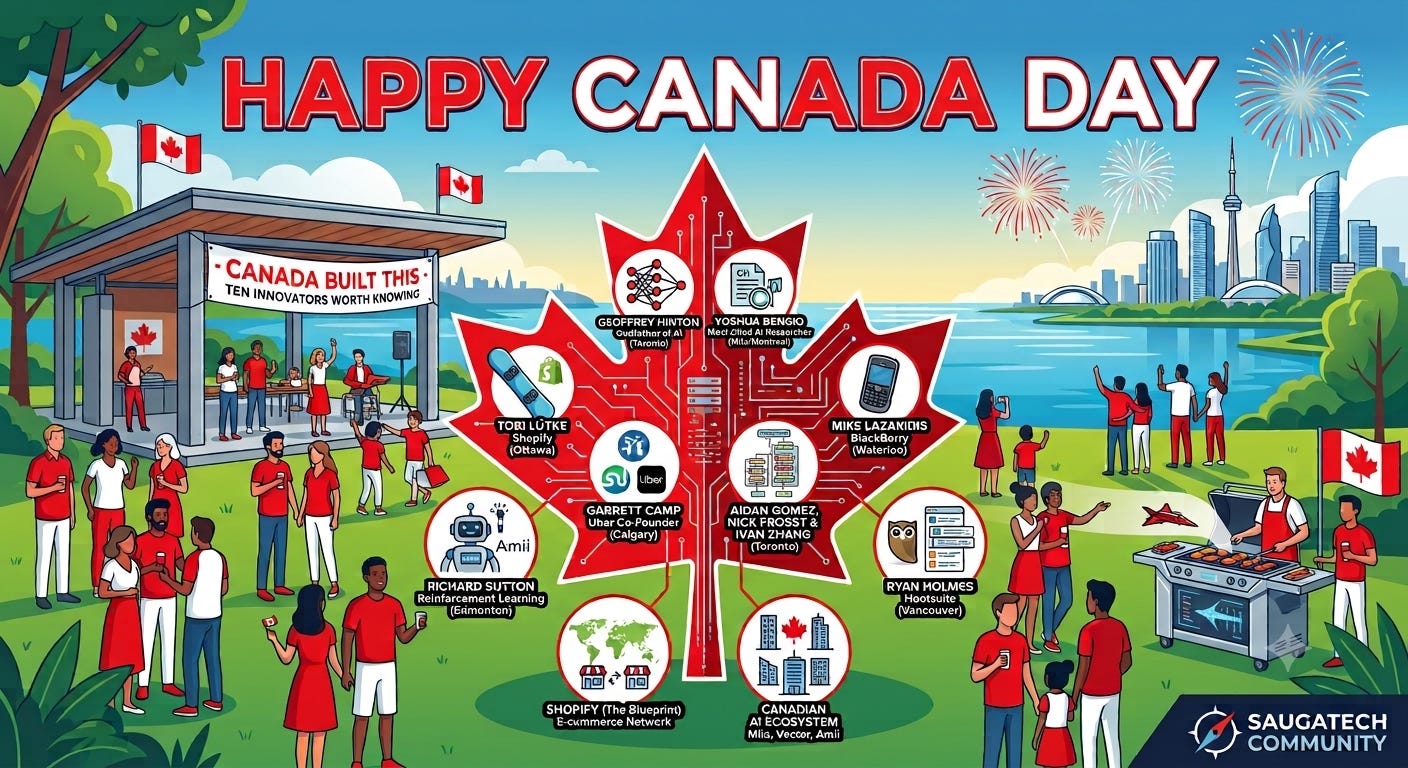
This Canada Day, we wanted to do something a little different with the Compass. No global tech drama this week. Just ten people and companies from this country who built something worth knowing about - in this millennium, in tech, in a way that matters.
This is your Canada Day reading list. Pour something cold. Let’s get into it.
⚓ Canada Built This — Ten Innovators Worth Knowing
1. Geoffrey Hinton — The Godfather of AI, Based in Toronto
If you’re reading this on a smartphone, using a voice assistant, or working with any AI tool, you are using technology that Geoffrey Hinton helped make possible.
Hinton came to the University of Toronto in 1987, at a time when neural networks were widely dismissed as a dead end. He kept working anyway. In 2012, his team — including his graduate students Alex Krizhevsky and Ilya Sutskever — built a neural network that won the ImageNet competition and cut the error rate in half. Overnight. That moment is now considered the starting gun of the modern AI era.
In 2018, he won the Turing Award, computing’s highest honour. In 2024, he won the Nobel Prize in Physics. He is known, simply, as the Godfather of AI.
He did it from Toronto.
2. Yoshua Bengio — The Most-Cited Computer Scientist in the World
Montreal-based Yoshua Bengio is the most-cited computer scientist on earth. Not in Canada. On earth.
Alongside Hinton, he pioneered the deep learning techniques that underpin virtually every major AI system in use today. Asked if he could draw a direct line from his work to ChatGPT, he said, simply: “Yeah, definitely.”
He won the 2018 Turing Award with Hinton and Yann LeCun. He founded Mila, the Quebec AI Institute, which has become one of the world’s leading AI research hubs. He now runs LawZero, focused on building AI that is safe by design.
Two of the three people most responsible for the AI revolution are Canadian. That fact deserves more barbecue conversation than it gets.
3. Tobi Lütke — Shopify
Tobi Lütke came to Canada from Germany, settled in Ottawa, and wanted to sell snowboards online. He couldn’t find a platform that worked well enough, so he built one.
That platform became Shopify — now one of the most valuable companies in Canada, powering over two million businesses across 175 countries. If you’ve ever bought something from an independent brand online, there’s a reasonable chance Shopify was the infrastructure underneath it.
Lütke is also one of the most thoughtful public voices on AI and the future of work, famously announcing that Shopify employees are expected to treat AI as a core tool rather than an optional add-on. He’s not waiting for the future. He’s building it.
4. Mike Lazaridis — BlackBerry / Research In Motion
Before the iPhone, there was the BlackBerry. Before the BlackBerry, there was Mike Lazaridis.
Starting with a $15,000 student grant in Waterloo, Ontario, Lazaridis co-founded Research In Motion and built the device that made enterprise mobile communication mainstream. At its peak, BlackBerry controlled more than 50% of the US smartphone market. Barack Obama refused to give his up.
BlackBerry’s moment at the top didn’t last. But its impact on Waterloo did. Lazaridis invested $100 million in the Perimeter Institute for Theoretical Physics and poured resources into quantum computing research. The tech ecosystem that now defines the Waterloo-Toronto corridor exists, in no small part, because of what he built and what he chose to put back.
5. Garrett Camp — Uber Co-Founder
Garrett Camp was born in Calgary. He studied at the University of Calgary. And then he co-founded two companies that changed how the world moves through cities and discovers things online.
The first was StumbleUpon, one of the earliest web content recommendation systems. The second — after a night of frustrating cab rides in Paris — was Uber. Camp conceptualised the idea, brought in Travis Kalanick, and helped transform urban transportation globally.
There’s a version of this story where Garrett Camp’s name is as well known as any other major Silicon Valley tech entrepreneur. It isn’t, partly because he’s Canadian. He keeps building and investing, mostly without the noise.
6. Aidan Gomez, Nick Frosst & Ivan Zhang — Cohere
In 2017, a team at Google Brain published a research paper that would become one of the most important documents in the history of computing. It was called “Attention Is All You Need.” It introduced the Transformer architecture — the foundation on which GPT, Claude, Gemini, and virtually every large language model is built. One of the co-authors was Aidan Gomez. He was 21 years old and studying at the University of Toronto.
Gomez went on to co-found Cohere with Nick Frosst — a fellow U of T graduate, former Google Brain researcher, and in a different life, a musician — and Ivan Zhang, who built the technical foundations of Cohere’s language model infrastructure. Together, they built the company Canada’s AI ambitions are being bet on: a Toronto-based enterprise AI platform competing at the highest level globally. Born right here in the 416.
7. Richard Sutton — The Godfather of Reinforcement Learning
If Hinton and Bengio built the foundation of deep learning, Richard Sutton built the foundation of how AI systems learn to make decisions. His 1998 textbook on reinforcement learning — co-authored with Andrew Barto — is still the definitive reference in the field. Every AI system that learns by doing, from AlphaGo to the models that train modern robotics, traces its lineage to Sutton’s work.
He spent decades at the University of Alberta in Edmonton, turning down opportunities abroad to build one of the world’s great AI research programs right here in Canada. Amii — the Alberta Machine Intelligence Institute — grew directly from that commitment. Sutton is proof that world-defining research doesn’t require a prestigious American zip code. It requires someone who believes deeply enough to stay and build.
8. Ryan Holmes — Hootsuite
Ryan Holmes didn’t set out to build a global software company. He built a tool to manage his own social media accounts more efficiently — and then realised the problem was universal.
That tool became Hootsuite, launched in Vancouver in 2008, and it essentially invented the social media management category before most businesses had a social media strategy at all. At its peak, Hootsuite served over 18 million users across 175 countries and became one of Canada’s most recognisable B2B SaaS brands globally. It proved that enterprise software with worldwide reach could be built from Vancouver just as easily as anywhere else — and that Canadian founders could define an entire product category, not just compete in one.
9. Shopify (as a company) — The Blueprint
Shopify deserves its own entry as a company, separate from Lütke, because of what it represents as a template.
It was built in Canada, for the world, headquartered in Ottawa, serving two million businesses across 175 countries. It proved that when Canadians back themselves, they can build at the highest level globally — and do it on their own terms.
The infrastructure is here. The talent is here. The next Shopify can absolutely be built right here — in Mississauga, in Brampton, in Oakville, anywhere a founder decides to start.
10. The Canadian AI Ecosystem — Mila, Vector, Amii
The final entry isn’t a person. It’s a bet Canada made before anyone else did.
In 2017, Canada became the first country in the world to launch a national AI strategy. The Pan-Canadian AI Strategy invested $125 million across three institutes: Mila in Montreal (Bengio’s house), the Vector Institute in Toronto (Hinton’s house), and Amii in Edmonton (Sutton’s house).
These institutes created the conditions for talent to stay, build, and compound right here in Canada. They created the conditions in which Cohere, Ada Support, and dozens of other AI companies were born. They were the room that the talent needed.
SaugaTech is not a national AI strategy. But the instinct is the same.
✨ SaugaTech Epilogue — The Only Thing Standing Between Us and Greatness
One of our team visited the RCAF Museum in Trenton this week. Walking through those hangars, past the artifacts of Canada’s Cold War aviation program, one story kept coming back.
In 1957, Canada unveiled the Avro Arrow — a supersonic interceptor that was faster, more technically advanced, and more capable than anything else flying at the time. Commercial supersonic jets like the Concorde were still a decade away. Canada had already built one for the military. The engineers who made it were among the best aerospace minds in the world.
When Canadians put their minds and belief behind something, they built the best technology on the planet. Full stop.
The Arrow proved it beyond any doubt.
The program was eventually cancelled — a decision that belongs to history. But the proof of what Canada can do when it backs itself? That’s permanent. No one can cancel that.
That same proof has been written again and again since.
Hinton stayed in Toronto and kept working on neural networks when the rest of the world said it was a dead end — and rewrote the future of computing. Lütke bet on himself in Ottawa and built one of the most important companies in the world. Lazaridis built BlackBerry in Waterloo and put enterprise mobile communication on the map. Gomez co-authored the paper the entire AI industry runs on, at 21, at U of T.
The talent has never been the problem. It never was.
The only thing standing between us and the next chapter of Canadian innovation is belief. Every great Canadian tech story started with someone who decided their idea was worth it, their city was enough, and their moment was now. That decision is available to all of us.
We have the talent. We have the track record. We have each other.
Let’s build like it’s Canada Day every day - with pride in our legacy, with inspiration from the Canadian trailblazers who have done it, time and again.
Let’s keep building, Let’s keep learning, Together.
Team SaugaTech
CONNECT | COLLABORATE | INNOVATE