Hi SaugaTech Community,
If you stepped outside in Mississauga this morning, you know exactly what kind of year we’re having. Last week it was 15°C and we were all convinced spring had arrived. Today it’s -8°C with a feels-like of -20°C. The weather genuinely cannot make up its mind.
Feels familiar, honestly. Neither can the tech industry.
But while everyone argues about whether we’re in an AI bubble or the beginning of something transformative, something quieter is happening across Canada. Companies are building things that work. Solving real problems. Making real revenue. No hype cycles, no moonshot obsession. Just good products that people need and are willing to pay for.
Google just announced its 2026 Accelerator Canada cohort: 14 startups that collectively raised $580 million and created 1,400 jobs since 2020. The funding numbers are impressive, sure. But what caught our attention was what these companies actually do and who they’re building for.
Grab a coffee. Let’s get into it.
🚀 First Things First: March 28 Meetup
Our next meetup is March 28 at IDEA Mississauga, Square One and we are almost out of spots. The session is called “Think It, Build It: Vibe Coding with AI Agents” and Aries will walk us through how he actually codes with AI tools before we build something together as a group. Really looking forward to getting the community in the same room for this one.If you haven’t registered yet, do it soon.
And join the SaugaTech WhatsApp Group to keep up with updates and get the conversation going before the session. Some of the best discussions from our meetups have started in that group days before anyone showed up.
Getting back to the Google cohort now.
What Canadian Startups Are Actually Building
Here’s a look at some of what Google’s 2026 cohort is working on.
CropMind out of Calgary helps farmers predict crop yields months before harvest. Planting decisions, irrigation, resource planning — farmers have always made these calls based on experience and instinct. CropMind gives them data to work with instead. Less waste, better planning, more stable supply chains.
EyeCareX in Vancouver is automating comprehensive eye exams. Canada has a real optometrist shortage, particularly in rural areas. People wait six months for appointments and by the time they’re seen, early signs of glaucoma or diabetes-related eye disease have been missed. EyeCareX speeds up screening so the doctors who are available can spend their time where it actually counts.
Innovate-Ops from Kitchener monitors industrial equipment and flags failures before they happen. Manufacturers lose thousands of dollars an hour when a production line goes down unexpectedly. These folks are selling the ability to keep things running, which is a very different conversation than selling software.
LandLogic in Toronto helps construction companies track land acquisitions and navigate regulatory compliance across jurisdictions. Nobody gets excited about permit tracking, but developers lose millions to delays caused by exactly that. More efficient development means more housing. That matters here.
Banting AI, also Toronto, gives physicians real-time clinical decision support. Doctors are swimming in information: latest research, drug interactions, treatment protocols. Banting helps surface what’s relevant in the moment. Better information, better decisions.
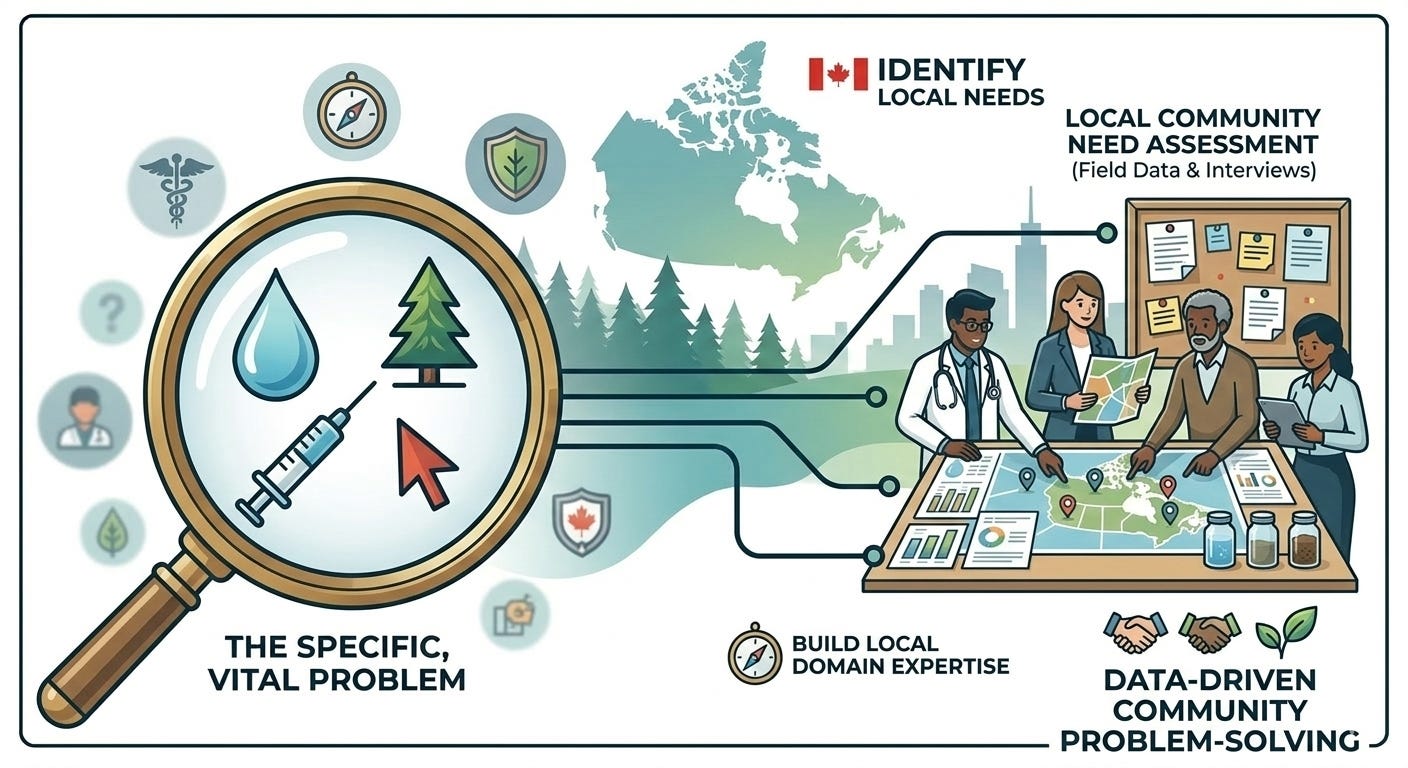
Every single one of these companies started by picking a specific problem and going deep on it. The technology came later. The customer never really cared about the technology anyway — they just wanted the problem gone.
What’s Happening Right Here in Mississauga
While Google celebrates its cohort, something just as meaningful is happening at IDEA Square One — which, if you were at our last SaugaTech meetup, you know well.
Xatoms is working on the global water crisis. Two billion people don’t have reliable access to clean water. They’ve developed photocatalysts using AI and quantum chemistry that can eliminate bacteria, viruses, pesticides, and heavy metals from water at a lower cost than what’s out there today. They’re already running pilots in Texas, Kenya, and South Africa.
DIA Labs Canada is building a continuous asthma monitoring device using microneedle technology. The problem with managing asthma today is that monitoring is reactive: you find out something is wrong when breathing becomes difficult. DIA Labs lets patients track inflammation in real time so they can get ahead of it rather than ending up in an emergency room.
Haami Lingerie is solving something the lingerie industry has largely ignored: plus-size women need bras that actually function comfortably. They’ve developed patentable technology for wireless, strapless, cupless bras designed specifically for this. Real pain point, real solution, real customers waiting for it.
Tea Time Therapy offers mental health services built specifically for the South Asian community. Culturally competent mental health care is genuinely hard to find. Thisanya built a space where South Asian clients feel actually understood, not just accommodated. No platform play. No AI angle. Just knowing your community and showing up for them properly.
Showstoppers Garage does car detailing, ceramic coatings, and tints. The innovation here is craft and customer experience. Saudia built a sustainable local business by being really good at something people care about. That counts.
All of these companies came through IDEA Mississauga’s Step-Up and Starter Company Plus programs. That support matters more than people realize. The difference between a good idea that goes nowhere and a real business serving real customers is often just access to the right mentorship, funding, and connections at the right time.
The Pattern Worth Paying Attention To
Look across everything above and a clear picture emerges.
These founders started by finding a problem, not by picking a technology. They spent time with the people living that problem. They understood it well enough that the solution became fairly obvious. Then they built the simplest version that could actually help.
Sometimes that involved sophisticated AI. Sometimes it was a service business with a great customer experience. The technology was always secondary. A farmer buying CropMind doesn’t think about the algorithm. An asthma patient using DIA Labs doesn’t think about microneedles. A woman buying Haami doesn’t think about the patent. They think about whether the problem is better now. That’s the only thing that matters.
AI can be an Enabler — Domain Expertise Is the Unlock
AI is genuinely powerful right now. Things that weren’t buildable three years ago are buildable today. That part is real.
But the founders in this piece aren’t winning because they know how to use AI. They’re winning because they know their problems inside out.
CropMind’s team has spent real time on farms. They’ve talked to dozens of growers. They know which decisions keep farmers up at night and which data points actually predict yields. The AI amplifies what they already know. Without that knowledge, they’d just be building another ag-tech product that farmers look at once and forget.
EyeCareX understands the clinical world from the inside: patient flow, regulatory requirements, the specific workflow bottlenecks that create backlogs. Their automation works because they know exactly where to apply it.
Innovate-Ops has felt the cost of unplanned downtime firsthand. That experience shapes every design decision: what to monitor, when to alert, how to communicate urgency to an operator in the middle of a shift.
This is the part that actually can’t be shortcut. Domain knowledge doesn’t come from reading reports about an industry. It comes from being in it. Sitting in the meetings. Living with the workarounds. Noticing the thing that everyone else stopped questioning because they assumed that’s just how it is.
Here’s the thing though: if you’ve spent five years in healthcare, finance, manufacturing, logistics, education, real estate — you already have that. You know where the friction is. You know the questions nobody bothers asking anymore. You know the processes that are held together with spreadsheets and hope.
That knowledge is genuinely hard to replicate. AI can make you move faster and build more efficiently, but it can’t tell you which problem is worth solving or why the existing solutions keep missing the mark. That comes from you.
What This Means for the Aspiring Builders in This Community — Start Small, Start Now
Here’s the honest reality of our community. Most of us are not 25 with two years of runway and no dependents. We’re working professionals with mortgages and families and responsibilities that don’t pause for a good idea. The stability we’ve built is real, and risking it feels irresponsible.
So the idea sits in the back of your head. You think about it on the commute. You mention it to a friend once. And then life keeps moving.
But the companies in this edition didn’t all start with a dramatic leap. They started by picking a specific problem and doing something small about it.
Start a side project. Keep your job. Find ten people who deal with the problem you’re thinking about and have honest conversations with them. Build the smallest version that could actually be useful. If you can charge even a little for it, do that early, because someone paying for something tells you more than a hundred people saying they like the idea.
ApplyBoard started by helping students fill out university applications. Clio started with helping individual lawyers track billable hours. None of these are revolutionary concepts. They’re just well-executed solutions to frustrations that a lot of people share, built by people who understood those frustrations well.
A few things that are worth keeping in mind:
Your industry experience is the advantage. The years you’ve spent in a particular field aren’t holding you back. They’re the reason you can see problems that someone coming from outside would completely miss. Talk to enough people in that world that you understand their day better than they can articulate it themselves.
Someone paying you is the real signal. A pitch deck, a waitlist, positive feedback from friends — none of that tells you much. Someone handing over money, even a small amount, tells you the problem is real enough to solve.
Start with one thing. Don’t try to build the whole platform. Solve one specific problem for one specific group of people and do it well enough that they tell others. Everything else can come later.
Use whatever technology actually helps. If AI makes the solution better, use it. If a spreadsheet is enough, use a spreadsheet. Customers don’t care how it works behind the scenes. They care that their problem is solved.
The problems are here. Manufacturing in the 905. Financial services downtown. Healthcare across the province. Agriculture in the areas surrounding the GTA. You don’t need to move somewhere else to find a problem worth solving. You’re probably already sitting next to one.
If what you build is genuinely useful to real people, things will happen. Maybe slowly, maybe differently than you expected. But real problems have a way of finding solutions, and the people closest to those problems are usually the best positioned to build them.
You don’t need to quit your job to start. You just need to actually start.
✨ SaugaTech Epilogue
The weather can’t decide if it’s spring or winter. The tech industry can’t decide if it’s a bubble or a revolution. Honestly, neither matters that much. What matters is whether you’re solving something real for someone who needs it. The rest is noise.
Every company we have mentioned in this edition started the same way: someone understood a problem deeply, found the people living with it, and built something that helped. Some used cutting-edge technology. Some did not. The throughline was never the tool. It was the problem.
So if you're sitting in a coffee shop in Mississauga or Brampton, squeezing in thirty minutes between school drop-off and your nine o'clock - this is for you. You don't need a co-working space and a pitch deck to get started. You don’t need a big launch. You don’t need investors. You just need to find ten people who share that problem and build something small enough to ship this weekend.
The problem you can’t stop thinking about is probably the problem you understand better than most people ever will.
Start there. Stay consistent. If the problem is real, things will happen.
See you on March 28.
Let’s keep building, Let’s keep learning, Together.
Team SaugaTech
CONNECT | COLLABORATE | INNOVATE