Hi SaugaTech Community,
If you’re reading this from a window seat at a coffee shop in Port Credit or looking out over a gray, salt-stained Square One, you know the vibe. It’s that classic mid-January GTA morning—a sky the color of a concrete slab and just enough wind off Lake Ontario to make the 401 commute feel like a daring arctic expedition.
But while GTA is frozen, the global tech landscape is heating up. We’re at a bizarre crossroads: exactly one year since the launch of the model that shattered the AI cost-curve, yet the Silicon Valley giants are still scrambling to find their footing in a world they no longer fully control.
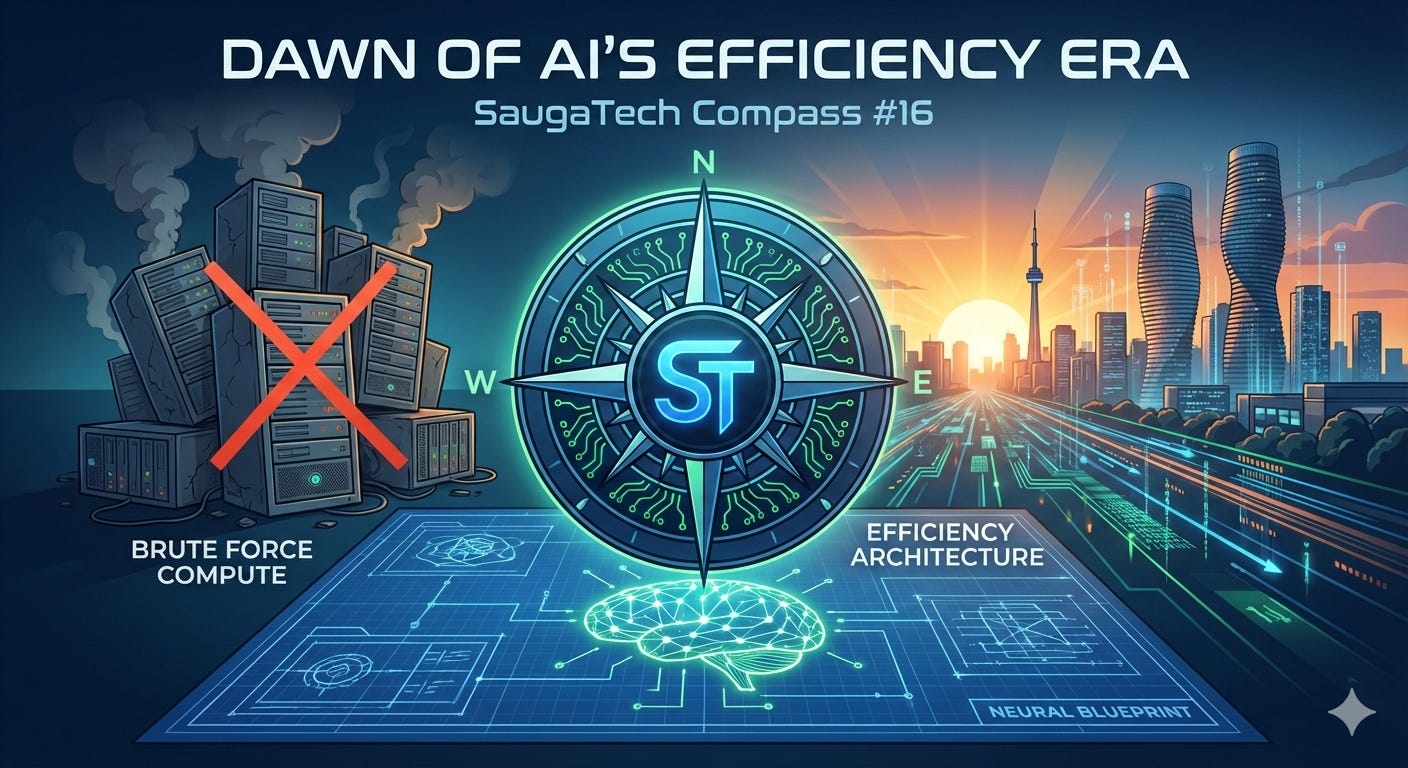
This edition of the Compass is a primer for the “Efficiency Era.” We’re deep-diving into the $6M breakthrough that changed everything, the transformative shift that OpenAI is going through, and how Canadian tech ecosystem is evolving in the midst of this perfect storm.
Grab a double-double,it’s time to move past the hype and look at the blueprints.
📋 In This Edition
🚀 First things First: Announcing “Beyond the Prompt”, our first meetup of the year for 7th Feb 2026 @ IDEA Mississauga, Square One
🧠DeepSeek R1 Anniversary: The $6M Shot Heard 'Round the World
🚨 The OpenAI Ads Conundrum: The last roll of dice or the logical next step
🇨🇦 The Canadian Signal: From Funded to Funder
⚖️SaugaTech epilogue : Why All of This is Relevant to us
🚀 First Things First: Beyond the Prompt (Feb 7th meetup)
We’ve spent two years as "prompt engineers," but in 2026, that’s no longer enough. The world has moved from Chat to Agents. To bridge that gap, we are officially announcing our first event of the year. This is our first one at IDEA Mississauga @ Square One, right at City Centre.
Beyond the Prompt: Building Your First AI Agent
A hands-on meetup to make AI agents easy to understand and even easier to build.
When - Saturday, February 7, 2026
Where - IDEA Square One (IDEA Mississauga)
Who should attend : Anyone who has heard about AI agents and wants to understand how to get started with them, without the jargon
More details in event RSVP link, Register here
Click here to Join SaugaTech WhatsApp Group for latest updates & much more.
💥 DeepSeek R1: 1 year since the $6M Shot heard 'Round the World
Exactly one year ago tomorrow, on January 20, 2025, a Chinese lab called DeepSeek released R1. At the time, it was called “AI’s Sputnik Moment.” Prior to that day, the “Gospel of Silicon Valley” was simple: To win at AI, you needed a $100 billion infrastructure fund and a personal relationship with Nvidia. DeepSeek took that gospel and threw it out the window.
The Math of the Revolution
DeepSeek-R1 matched the reasoning capabilities of OpenAI’s best models but was trained for a reported $5.6 million.
OpenAI o1/GPT-5: Estimated $100M+ per training run.
DeepSeek R1: $5.6M (less than the cost of a decent Series A in Toronto)
They achieved this not with brute force, but with architectural elegance—specifically, Multi-head Latent Attention (MLA) and a Mixture of Experts (MoE) that only “woke up” the specific parts of the model needed for a task. It’s like having a library of 600 experts but only paying the 2 who are actually relevant to your question.
The Science: Why “Bigger” Is No Longer “Better”
What DeepSeek proved in the marketplace, recent research from Johns Hopkins University has now confirmed in the lab. A study published recently in Nature Machine Intelligence by Dr. Mick Bonner and his team shows that brain-inspired AI designs can mimic human brain activity with little to no training data. By tweaking the architecture of neural networks to better resemble the biological visual cortex, they found the AI could produce brain-like neural patterns de novo—before seeing a single image.
This is exactly what we saw with DeepSeek: smarter design allowed them to bypass the “brute force” spending of their competitors. It suggests that if you start with the right “biological blueprint,” the model is already in an advantageous starting point.
🚨 The OpenAI Ads Conundrum: The Last Roll of the Dice or the Logical Next Step?
While DeepSeek spent 2025 proving that intelligence is getting cheaper, OpenAI has spent it realizing that being the world’s “super-assistant” is getting ruinously expensive. Last Friday, the rumors finally became reality: Ads are officially coming to ChatGPT. For a company that once called AI-plus-ads “uniquely unsettling,” this pivot signals a massive strategic gamble. Is it a desperate move to fix a $115 billion burn, or the logical evolution of a platform that now serves 800 million weekly users?
The “Instagram” Pivot: Monetizing the Masses
The new ads will roll out first in the U.S. for the Free and the newly launched $8/month “Go” tiers. Sam Altman—who once claimed to “hate ads as an aesthetic choice”—now points to Instagram as his inspiration, suggesting that ads can be “useful discovery.” OpenAI’s pitch to users is simple: to keep providing world-class intelligence for free (or cheap), someone has to pay the bills. They’ve promised strict guardrails: ads will sit in clearly labeled “tinted boxes” at the bottom of the screen, won’t appear for users under 18, and—crucially—OpenAI claims they will never accept money to influence the actual text of an answer.
The User Dilemma: A "Zero-Trust" Interface?
This move creates a fascinating friction for the average user. If you are sitting in the Square One food court, why would you tolerate “Sponsored Suggestions” in your chat when Google Gemini 3 is free, faster, and currently ad-free? The problem isn’t just the annoyance; it’s the eroded utility.
Imagine you’re asking for the “most reliable family SUV with high safety ratings” for your commute on the QEW.
The Gemini Experience: You get a synthesized list of crash test ratings and consumer reports—pure information.
The New ChatGPT Experience: You get the list, but it’s followed by a “Sponsored Recommendation” for a specific local dealership or a brand that paid for placement.
Suddenly, you have to wonder: Did the model pick the safest car, or is it subtly nudging me toward the one that helps OpenAI pay its electricity bill? This "monetized reasoning" creates a massive opening for Google. Gemini 3 has already surged to a 21% market share this month because users are prioritizing a "clean" signal over ChatGPT’s conversational "vibe."
The Signal for 2026: The “Neutral Architect” era is over. If you want an unbiased assistant, you’ll soon have to pay a premium for the $20 Plus tier or the $200 Pro tier. For everyone else, ChatGPT is transitioning from a tool into a marketplace.
🇨🇦 The Canadian Signal: A maturing innovation ecosystem
While Silicon Valley enters its “Ad Era,” Canadian tech moving from the “Getting Funded” phase to the “Allocating Capital” phase.
Lightspeed: The New International Capital Allocator
The biggest signal of maturity comes from Montreal’s Lightspeed Commerce. Historically, a “Canadian success story” meant a company that eventually got bought or raised money from California. Today, Lightspeed is flipping the script. They are currently structuring a $500M Fund specifically targeting startups in India and Southeast Asia.
The Strategy: Keeping HQ and IP in Canada while deploying capital into the world’s fastest-growing markets.
The Shift: Canadian Tech ecosystem isn’t just building the tools anymore; we are funding the global infrastructure of commerce.
✨ SaugaTech Epilogue: Why should this matter to us
The noise is for the spectators; the signal is for the builders. The fact that it is January 2026 and we are still talking about the legacy of a $6M model from 2025 proves that the “Compute Moat” was a myth. The Johns Hopkins research confirms it: intelligence isn't about the size of the city you build to house your servers; it's about the elegance of the blueprint you use to build your brain.
The key takeaways for us as a community of builders in Canada are as below:
Cost: You can now build world-class tech for a fraction of what it cost two years ago, its only a matter of intent
Stop being an “OpenAI Wrapper”: As they pivot to ads, their logic may become biased. Use the “Efficiency Era” tools to build your own sovereign logic. Small Language models may be the way to go
Architectural Advantage: You don't have to wait for a "God Model" from California that is trying to sell your users a credit card. You can use brain-inspired, efficient architectures to build tools that you own.
Whether you are a student at UTM just starting your first Python script, or a founder scaling your third venture, the “Efficiency Era” belongs to you. We don’t need to out-spend Silicon Valley; we just need to out-build them.
Stay warm, stay curious, and we’ll see you on February 7th to build the future together.
Team SaugaTech
CONNECT | COLLABORATE | INNOVATE